Rating: 10/10
Review:
Mohandas Karamchand Gandhi is omnipresent today: the most recognised Indian in the world and a mandatory reference name for almost everyone speaking of peace. You can find him peering at his people from crisp Indian money notes, looking down from portraits in government offices, smiling from T shirts and flairs, repackaged for a new generation, and quoted so often that it would probably make him dizzy.
The simplistic saintly Mahatma (Great Soul) of our textbooks, is a depiction that does no justice to the immense complexities and controversies that Mohandas Gandhi faced and overcame. For what makes Gandhi so great is not the fact that he was flawless. Gandhi's place among the most unforgettable men of the millennium came from the fact that he was greater than the flaws that he tried valiantly to overcome. The Mahatma is an outstanding example of the greatness that human beings can aspire to.
Rajmohan Gandhi's magnum opus biography of his grandfather Mohandas is a stunning, beautiful, unforgettable, emotional passage to understanding Bapu, one that takes your breath away as it reveals the sheer magnitude of what Gandhi lived through and achieved.
Mohandas' childhood in Gujarat, where he grew up watching his mother fast on religious occasions, where his nurse Rambha taught him to recite the holy name of Lord Rama whenever he was nervous, where he resolved that he would go out of his way to make Muslim friends, even if he didn't make many Hindu friends, is far more important than people probably think. As we can see, events of his childhood instilled the beliefs that would inspire him while leading a nation.
A fashionable Mohandas went to London to study to become a barrister. Vegetarianism, agnosticism, love and respect for friends of different cultures and religions enchanted him. He wanted all citizens of the Empire to be treated equally and many aspects of the English way of life inspired him.
But it was South Africa that marked the biggest turning point of his life. As Nelson Mandela would later say, “You gave us Mohandas; we returned him to you as Mahatma Gandhi”. Facing up to racism and injustice to the Indian community in South Africa, the lawyer Mohandas wrote to newspapers opposing unjust laws and traditions. And more importantly, protested and mobilized several people to protest non-violently. Tolstoy farm, where 'untouchables', people of many religions and countries would live and work together, was a big inspiration for Gandhi. Traits of what India would see Gandhi present to her as solutions to long-suffered problems, are visible already.
India soon called for her prodigal son and his return to his homeland changed India forever. Travelling third class to discover the real India, Gandhi was clear of the three issues he would focus on: Hindu-Muslim unity, bridging the shameful gap between upper caste Hindus and 'untouchables' and preparing the country, from the villages, to be worthy of freedom. These were issues that would haunt India in the lead-up to Partition and he was prescient enough to understand that very early. Satyagraha and ahimsa became his 'weapons' of choice, as he rejuvenated a party of elite lawyers and urged the Congress to really represent the millions who toiled in the villages of India.
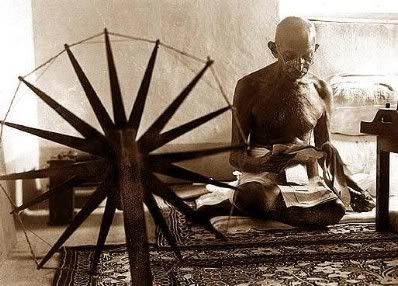
The political Gandhi was born out of necessity. For there was little social and religious reform he could do without sorting out the politics of India. Gandhi was the hero of Champaran, the initiator of non-cooperation, the controversial creator of Quit India, the exquisite strategist, publicist of the Dandi March. A prolific letter writer, Gandhi wrote regularly for his newspaper Harijan, mentored Nehru, Patel and the top brass of the Congress: his political 'sons' and wore just the minimum of hand-spun cloth in solidarity with the masses of India, many of whom had nothing to wear.
His experiments with brahmacharya/celibacy (which sometimes involved sleeping naked beside women of his ashram) are no doubt as bizarre and controversial now as they were then, when Gandhi made no attempt to hide it. His usage of religion in politics has been criticised by some, but he understood the importance of religion in every walk of life in India and used it to spread only one message: that all religions preached love, tolerance and goodwill.
What makes the Mahatma incredible is not just the space and respect he gave to those who disagreed with him, but the earnest effort he made to understand their point of view and even change his opinion if need be. His conversations with Tagore and Ambedkar are a case in point. That Gandhi practised what he preached, is what attracted the world to him. He was the change he wished to see in the world, even if the change he wanted to see, was different from what others wanted to see. Gandhi specialised in holding a high moral ground by loving his enemy.
Churchill, who with great sensitivity asked the Viceroy when the Mahatma was fasting, if Gandhi hadn't died yet, spoke of blood, toil, tears and sweat. So did Gandhi. Except, he spoke of blood, sweat and tears shed by a man who toiled and protested with great courage, non-violently. After all, 'non-violence is a weapon of the strong'.
Even if people had thought him distant and out-of-sync with reality, it was Gandhi who healed some of the many wounds of Partition. Fasting for peace, especially when Delhi was in the throes of horrifying Partition violence, was his ace card of sorts. While Dandi and Quit India might have become the most popular expressions of Gandhi and his triumphs, his greatest moment, without a doubt, came while visiting areas tormented by religious violence.
Be it Noakhali, Bihar, Delhi or Calcutta, wherever Bapu (Father of the Nation) went, he cured the insanity of communalism, he healed wounds with his overwhelming humanity, he spoke the language of love to those who had seen devastation on a scale that would crush India. He made Hindus, Sikhs and Muslims who attacked and killed members of the other community repent and promise him that they would protect each other always. His prayer meetings where chants from all religions were recited, whispered peace to ears that had been plugged by the shattering noise of violence. And such was his impact. Sample this excerpt from the book:
Interviews conducted in Noakhali in April and November 2000 (53 years after Gandhi had been there) found residents retaining precise memories of Gandhi...many recalling him spontaneously recited or sang 'Raghupathi Raghav Raja Ram..Ishwar Allah Tere Naam'
Rajmohan Gandhi writes with a neutrality that is incredible for a man writing about his grandfather. His writing is simple, evocative and poignant, quoting from myriad sources, interpreting and drawing parallels with great sensitivity and shedding light on the lesser known aspects of Gandhi's life, such as the troubled relationship that Gandhi had with his sons. Rajmohan captures the legendary sense of humour of the Mahatma, as also his relationship with the men who would go on to govern India. Mohandas: A True Story of a Man, his People and an Empire is a masterpiece that every Indian ought to read and I have no hesitation in saying that Bapu would be very proud of his grandson's work.
Incessant tears poured down my cheeks throughout the last pages of the book, the ones dealing with Gandhi's assassination and the world's response to it. In death as in life, Gandhi united Hindus, Sikhs and Muslims, both in India and Pakistan. Indians wept in grief and normal life was forgotten, for 'the light has gone out of our lives and there is darkness everywhere'. Many Pakistanis skipped their meal that night, to mourn the loss of a remarkable human being. Said Pakistani leader Mian Iftikharuddin, "Each one of us who has raised his hand against innocent men, women and children during the past months, who has publicly or secretly entertained sympathy for such acts, is a collaborator in the murder of Mahatma Gandhi"
If I had to condense the life of Mahatma Gandhi, three words would do it: he loved everyone. That overwhelming, incredible, majestic, ever-flowing love for men, women, children; Harijans, Muslims, Hindus, Sikhs; Englishmen and women, Germans, Americans, Africans. The world was his family and he couldn't stand a single act of violence that would harm his family. And that reasoning, is possibly why 'generations to come will scarce believe that such a one as this ever in flesh and blood walked upon this earth.' To all those protesting peacefully in every part of the world for what is right, be it during the recent 'Arab Spring' or under the guidance of Martin Luther King Jr, Aung San Suu Kyi or Nelson Mandela, Gandhi's message is worth remembering: 'My life is my message'. This book is an unforgettable journey to understand that message.