Showing posts with label Politics. Show all posts

Sunday, October 17, 2010

Rich Like Us - Nayantara Sahgal

Rating: 9/10

Review:

Rich Like Us is a snapshot of India and her people before and after independence, and the story of how the Emergency of 1975 ruined the democratic values that this country was founded upon. This is a story told through the lives of two women - the 'Cockney memsahib' Rose and the young, well-educated, unconventional Sonali. I went in looking for a tale about the Emergency but this book is a chronicle of the ills, weaknesses and strengths of a country so complex that it would take more than a lifetime to 'discover'. 

Sahgal's writing is beautiful, sometimes almost lyrical while at times overboard with metaphors. Nevertheless, to convey powerful ideas and opinions in a deceptively simple style is a great achievement indeed. This book is very quotable too. Sample this:


'Only the perfect relationship can be utterly destroyed the moment one fine hairlike crack appears in the structure, when betrayal becomes a matter of one person ordering fish and chips for dinner instead of the stew agreed on, and a chapter read separately out of a book two were reading together.'


It is very easy to see why this book won the coveted Sahitya Akademi award and the Sinclair Prize and equally difficult to see that not many even in India read Sahgal's books! I can only say that you're missing out on one of the most wonderful writers I've read, one who has a keen eye for history and politics and seamlessly intertwines the both in her books.

The two female protagonists in this inherently feminist book which feels no need to shout out its feminist theme from the rooftops, are amazingly interesting and beyond cliches. Both the strength and something of a weakness of this book, is the fact that Sahgal deals with so many themes from sati to corruption to religion to the British Raj to Ramayan to partition to politics which on one hand is an amazing collection of thoughts and on the other, might be too overwhelming and sometimes irrelevant. 

Politics forms a major part of the book and Sahgal, a well-known critic of her cousin Indira Gandhi, minces no words in slamming Mrs.Gandhi's emergency and her nepotism in bringing up her son Sanjay to a position of great power. Of course not once does she mention either Indira or Sanjay by name (she calls them 'Madam and her son' instead), but she doesn't need to. Her sharp sarcasm and dry sense of humour sparkles and makes this book all the more exciting.

Sahgal dedicates this book to  'The Indo-British experience and what its sharers have learned from each other' . That is exactly what the book is all about, in addition to being a wonderful experience for the reader that I highly recommend.

Monday, September 6, 2010

Curfewed Night - Basharat Peer


Rating: 10/10

Review:

If a book’s greatness is measured by the impact it has on its reader, then Curfewed Night is indeed a great book. This part-autobiographical tale of Kashmir written by journalist/writer Basharat Peer is a must-read for every Indian, for the simple reason that this is, finally, the story of Kashmir as told by a Kashmiri.

In the feverish discussions and deliberations about conflicts, most analysts, ‘experts’ and even the common man talk only in terms of the ‘issue’. Kashmir is discussed in several angles; as a political, economic, ethnic, religious and strategic issue. In all such intellectual discussions, we often miss out on the angle that matters the most; the emotional, human side to the problem.

Curfewed Night is a harsh reminder of the troubles and travails borne by the common man of Kashmir. It is an uncomfortable, hurtful, unforgettable, even embarrassing read and Peer writes with such clarity and indeed calm, even while recounting many a personal tragedy or loss. What strikes me most about this book is the fact that nowhere does Peer make judgements, nowhere does he unleash hatred, and nowhere does he take sides politically. It is precisely this that makes the book so powerful; the fact that it is written from the heart and the fact that because it talks of events and issues from a personal angle, it seems so much more real and striking to us.

Indeed Curfewed Night was for me a journey into the ravaged valley with the author, while understanding his life, his convictions, his family, friends and his Kashmir. Peer’s writing is beautifully simple, innately evocative and sometimes almost poetic, conjuring images of his time in the valley and the people who form a part of his journey. This is one of those books by the end of which you feel you know the author very well and begin to care for them and hope there is a ‘happy ending’ in sight.

Peer talks about his initial fascination for militancy, the journey to study outside Kashmir, becoming a journalist and coming back home. Alongside personal accounts, he talks of the scheme of things in Kashmir at that point, be it the aftermath of the Parliament attack or the Indo-Pak bus service.

The narrative might seem disjoint at times, but it never hampered my reading of the book because in my mind, Curfewed Night wasn’t as much about Kashmir alone as it was about Kashmiris. This book moved me to tears more than once and was an emotional journey for the reader too, not just the writer. I’m very glad that I read this unforgettable account written with such passion that is hard to dismiss.

Peer is a writer to watch out for and I’m looking forward to whatever he writes in future. Curfewed Night has been long listed for the Guardian first book Award and here’s wishing Peer all the very best. I’m thankful to him for giving us a book that must have taken a lot of grit and determination to write.

Needless to say, I’m adding this book to my list of India-related book recommendations.

Friday, June 4, 2010

Young Turks - Krishan Partap Singh


Rating: 7/10

Review:
If I had to sum this book in a sentence, I would say this is a watered-down Jeffrey Archer style political thriller that is worth reading, if just to stay away from boredom. Because that is one thing I can be quite sure of, as far as this book is concerned. Predictable, it is. Unbelievable in places, yes. Boring? Definitely not. This is an excellent page-turner in the best sense of the word.

Having heard so much about Krishan Partap Singh and knowing my like for political fiction and non-fiction, I picked Young Turks. This is the story of Karan Nehru and Azim Khan, childhood friends, accidental entrants to politics and later, cabinet ministers. A friendship that has endured and flourished over the years stands in grave threat of collapsing, when the Prime Minister's chair is waiting for one of them to take over. Who will it be?

Reminiscent very mildly of Archer's Kane and Abel for the powerful lead characters, Young Turks is worth reading if only for the heady mix of history, politics and patriotism that it provides. The different struggles that the men face in their political and personal life are chronicled in an easy, interesting style. Karan Nehru, a man who holds a surname of astronomical importance in Indian politics, is the brash, outspoken, vivid, fun type. Azim Khan, a fierce patriot who insists on putting his country before his religion or anything else, is soft, sensitive, practical, intelligent and honest. I couldn't help but admire Azim for his clear, sensible vision for his country, while I thought Karan is a fun yet very predictable character.

I feel the book stops itself from being an epic political thriller because it glosses over and moves too quickly from scene to scene, time period to time period. Singh explains a lot of political, diplomatic and military issues to aid the reader in understanding the intensity of each situation. I admired that the author paid tribute to Jawaharlal Nehru- the 'architect of modern India', by adequately and rightly referring to and praising the great man that he was, in this book. The political speeches of the characters are well-written; just what a common man would like his leaders to say. The book also sends a simple but important message, that of a united, strong India. 

I had some problems with the book, one of which was the implausible final events leading to the climax. It was just too dramatic and unbelievable in my opinion. Another thing that irked me was the presence of grammatical mistakes, spelling errors ('foriegn' minister?!) and typos in the book. I dearly wish the editor had checked through the book well enough and avoided these errors that irritates the reader.

In conclusion, Young Turks is a great way to pass time, especially if you're in the mood for a page-turner or a political thriller. Krishan Partap Singh writes in an easy style that would attract all readers and I'm looking forward to reading the other two books which along with Young Turks forms The Raisina Series. I hope Singh gives Chetan Bhagat a run for his money!

This book rounds up the ten books I needed to read for the South Asian Author Challenge hosted by S.Krishna's Books. Needless to say, I'll continue to read a lot of Indian authors. Expect a challenge review post coming up soon :)

Wednesday, March 17, 2010

Nehru : The Making of India - M.J.Akbar


Rating : 10/10

Review:
There are some books I'm nervous of reviewing: books that are absolutely magnificent, epic and in every sense of the word, a brilliant read. There's always a feeling that my review will not do justice to the greatness of the book. That's the case as far as this book is concerned, but I'm trying my best to put to words my thoughts of a 584-page masterpiece most of whose pages have dogears as I over-excitedly marked pages I loved. Which soon turned out to be almost every page.

Jawaharlal Nehru's life is one that saw the birth and 'making' of a nation. He was, in many ways, the architect of modern India and his life is as complex, brilliant and complicated as it can get for any biographer. But M.J. Akbar more than handles it with ease. This biography is not an exercise in worshiping India's first Prime Minister. Rather, it analyzes with great sensitivity and impressive neutrality.

Akbar isn't afraid of criticising Nehru where the criticism is needed, but he is equally generous in praising the man who inherited a broken, poverty-stricken, injured India after partition and rejuvenated her considerably.

Some issues are dealt with in-depth, particularly the Hindu-Muslim ties that was an issue that persisted throughout Nehru's life, the wonderful relationship between 'Bapu' Mahatma Gandhi and Nehru and of course, foreign policy issues, especially the 1962 China war. It is essential that these issues are explained well because most of Nehru's life dealt with it and Akbar does an admirable job of introducing the reader to some concepts and issues, without preaching to them.

But the book isn't just about the 'serious' side of Nehru. Akbar's witty writing style can hold his own in non-fiction, much like his earlier Kashmir: Behind The Vale. His eye for irony, detail and the unknown trivia that amazes you, is one of the greatest advantages of this book. 

Several witty incidents, interesting moments that reveal this great personality make for wonderful reading. I particularly loved how Akbar gave the reader a clear, important insight into Nehru's childhood and early time in politics which had several moments that inspired and influenced Nehru's later policies and life.

Enough emphasis is laid on the important people in Nehru's life,  like father Motilal, daughter Indira, colleagues like Maulana Abul Kalam Azad and many others. Akbar, ever the sensible journalist, draws quick insightful references from Nehru's life to the Nehru-Gandhi family that occupies an ever-significant place in Indian polity.

This book took me several months to read, though admittedly, this wasn't the only book I read. It was also because I wanted to take in and save in my mind whatever I was reading because this is by no means a light read. But it is a more than rewarding read which takes you on a journey through the great man's life and moves you tremendously at moments, while still clearly explaining the mistakes and flaws in his career. 

Nehru: The Making of India, much like Nehru himself, is inspiring, patriotic, wonderful, epic, complex and unforgettable. I shall go back to this book several times again and again because it's the kind of book worth cherishing. And if this doesn't make the book sound good enough, the fault is entirely with my review and not the magnificent book.

Wednesday, December 30, 2009

This Time Of Morning - Nayantara Sahgal


Rating : 8/10

Review: 
Capturing an India in transition mode, facing the challenge of governance after independence, while still sore from the wounds of partition, seems like child's play for Nayantara Sahgal. This Time of Morning is an unforgettable snapshot of Delhi and the people, young and old, who inhabit it.  

There are several characters in the book which makes it initially confusing and a bit of an overload. But by the time you warm up to it you're in for a rewarding read. The more characters there are, the more view-points Sahgal presents about India post 1947, the changes in  society, the struggle for identity and of course, politics. 

Sahgal examines politics, life, bureaucracy and political situations with deceptive simplicity. She's almost always spot-on analyzing the struggles of revolutionaries who suddenly find themselves as politicians, countering a corrupt set of individuals who play dirty. She captures and brings to life the Gandhian struggle for independence with as much ease as she talks about the morally corrupt who were always there in the scene in the Congress, but became more prominent taking power after 1947.

The characters go into flashback mode quite a lot and if these flashbacks had been demarcated separately it would have been so much clearer. Then of course, there is the problem you face when there are too many characters: the one you thought was the protagonist is actually not. In fact, there is no single protagonist in this book, which is quite a good thing actually. Also, there is a feeling that some characters got more book space than the others.

But all these flaws are negligible in view of this magnificent portrayal of Delhi after independence, that will stay with you long after you're done reading the book. Nayantara Sahgal is an immensely quotable writer, who is a joy to read.

Monday, November 2, 2009

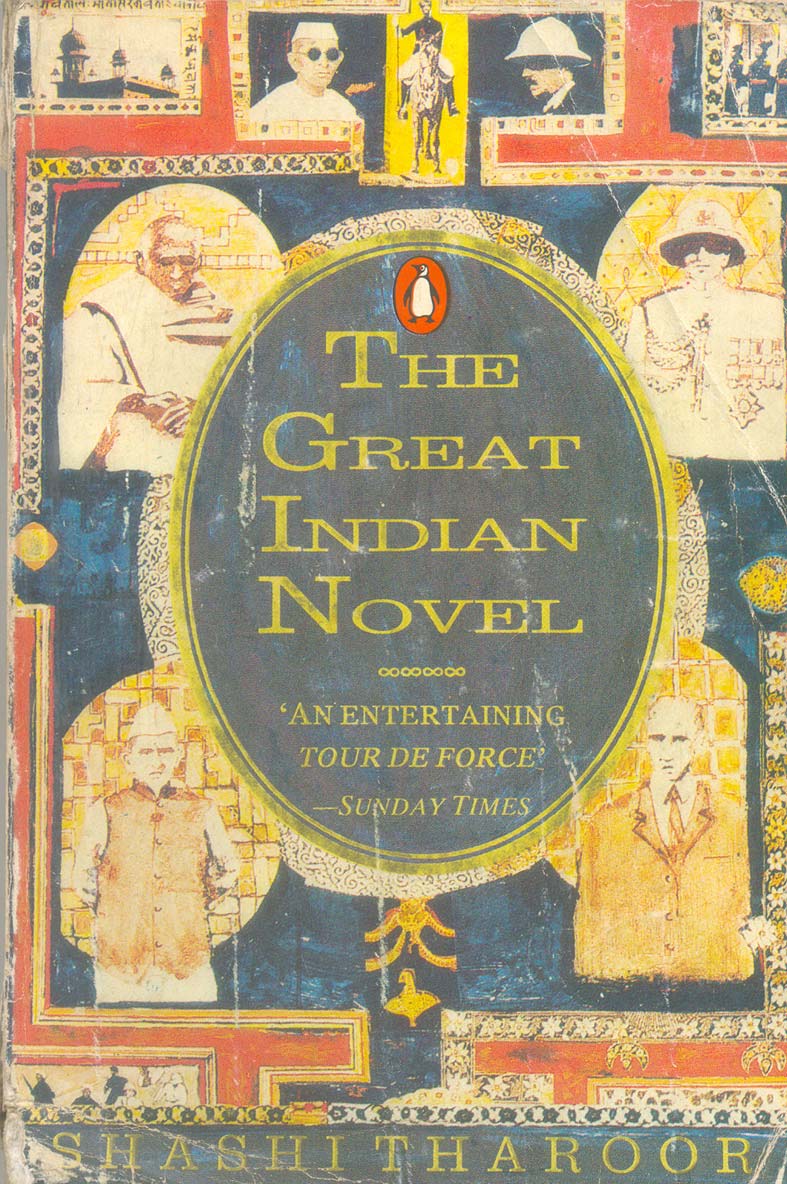
The Great Indian Novel by Shashi Tharoor


Rating : 10/10
Yes, it is that good. If you love the Mahabharata and love to discuss Indian politics and haven't read this book yet, go pick it. Now. You'll never regret it!

Review:
One of the first pages of the book has a note from the author which goes:
''A hasty note of disclaimer is due to those readers who may feel, justifiably, that the work that follows is neither great, nor authentically Indian, nor even much of a novel. The Great Indian Novel takes its title not from the author's estimate of its contents but in deference to its primary source of inspiration, the ancient epic the Mahabharata'

This modesty-affected disclaimer isn't quite necessary since this novel indeed is, a Great Indian Novel. The Mahabharata is India's epic and politics, of course, our epic passtime and to bring them both together sounds epic. But can Shashi Tharoor pull it off?

The Great Indian Novel is the song of India- its great epic and its great struggle for independence and (later) democracy, interwoven inseparably. The relevance of epics is oft spoken about, but you hardly get to see the 'relevance' put in front of your eyes like you do here.

With a keen, often too sharp sense of humour, a vivid narrative, often lined with inside jokes, Tharoor has written what is probably the greatest Indian political satire I've read. Thoroughly entertaining, be it verse or words, with unexpected turns of philosophy, wicked humour, breathtaking creativity and a clear sense of emotion and patriotism, The Great Indian Novel and its characters are memorable to say the least.

To the reader who's always been interested in Indian politics, this book could soon become your haven. Tracking references, 'getting the joke', trailing hints, often staring wide-eyed at pages wondering how someone managed to take such liberties in pulling the leg of our 'national icons', The Great Indian Novel has a sort of excitement and thrill that the likes of The Da Vinci Code can never achieve.               

While reading the book, I did think to myself that I should probably not be enjoying the book this much. And even if I did, its not all credit to Tharoor, for the The Great Indian Novel is more or less 'The Mahabharata Remixed'. Isn't it? But no, inter-connecting our mythical/religious heroes and our national leaders in a way that is spell-binding, in a way that would make you sit up, is no easy task ( I can think of a hundred ways how this book could have gone Oh-so-wrong ) and precisely why this book is a triumph.

Thanks to my friends for gifting this book for my birthday last month. It's definitely one of the best books I've ever read and probably the best book I've read so far, this year! =)

Wednesday, October 7, 2009

Sheikh Mohammad Abdullah: Tragic Hero of Kashmir by Ajit Bhattacharjea


Rating: 8/10

Review: Ever since I read M.J.Akbar's book Kashmir: Behind the Vale ( My review of the book is here), my fascination about all things Kashmir has just reached an apex point. This book, obviously, was my best bet.

Released recently by a reputed journalist Ajit Bhattacharjea, it seemed to provide a comprehensive biography of the intriguing personality that is Sheikh Abdullah.It does justice to that first impression.

The book is obviously well-researched and is neatly presented(foot notes abound). The story of a young man belonging to a poor family of weavers growing up to be an inspirational teacher, later standing up and fighting against the autocracy of the Maharaja, making a clarion call for unity and secularism in a troubled valley, developing a strong relationship with fellow Kashmiri and Indian PM Jawaharlal Nehru( The book does great justice to the relationship, examining it beautifully ), being jailed and undergoing great struggles to pick between accession and autonomy and his final place in power as CM of Jammu and Kashmir, is a story that legends are made of.

This book is typical non-fiction. Strong in facts, presenting a hundred references, making it evident that a lot of work has gone in to come up with this biography. But there's something missing in the book. There isn't any sparkling witty remark or comment a la Alex von Tunzelmann or Shashi Tharoor. There isn't any tongue in cheek observation- the writing is old school.

What hits me most though is the lack of emotion in the most important parts of the book. I'm not sure about other readers of non-fiction or biographies, but, for me, the emotion that the author brings in to the biography is very crucial. After all, without that emotion, isn't the biography a mere compilation of facts?

The life of Sheikh Abdullah was tumultous and certainly very emotional. I expected several parts to make me teary-eyed, but they didn't. In comparison, the relatively small chapter about Abdullah's death in M.J.Akbar's Kashmir: Behind the Vale had me in tears, while this book did absolutely nothing to me emotionally, though it is most certainly a rewarding academic exercise.

Finally, to the thing that irritated me most in the book: editing or the lack of it. I can quote one dozen examples of grammatical errors, bad punctuation and basic spelling mistakes! It is such a shame that such a painstakingly researched book has to suffer from lackadaisical, abysmal editing. If I, while reading the book without any intention of finding mistakes, can come up with an entire list of errors in a single reading, what happened to the copy editor, whose job it is to find these mistakes?

Over all it is an excellent contribution to books about Indian political figures, though one wishes that issues like editing had been better taken care of.

LinkWithin

Related Posts with Thumbnails
Protected by Copyscape Online Plagiarism Test